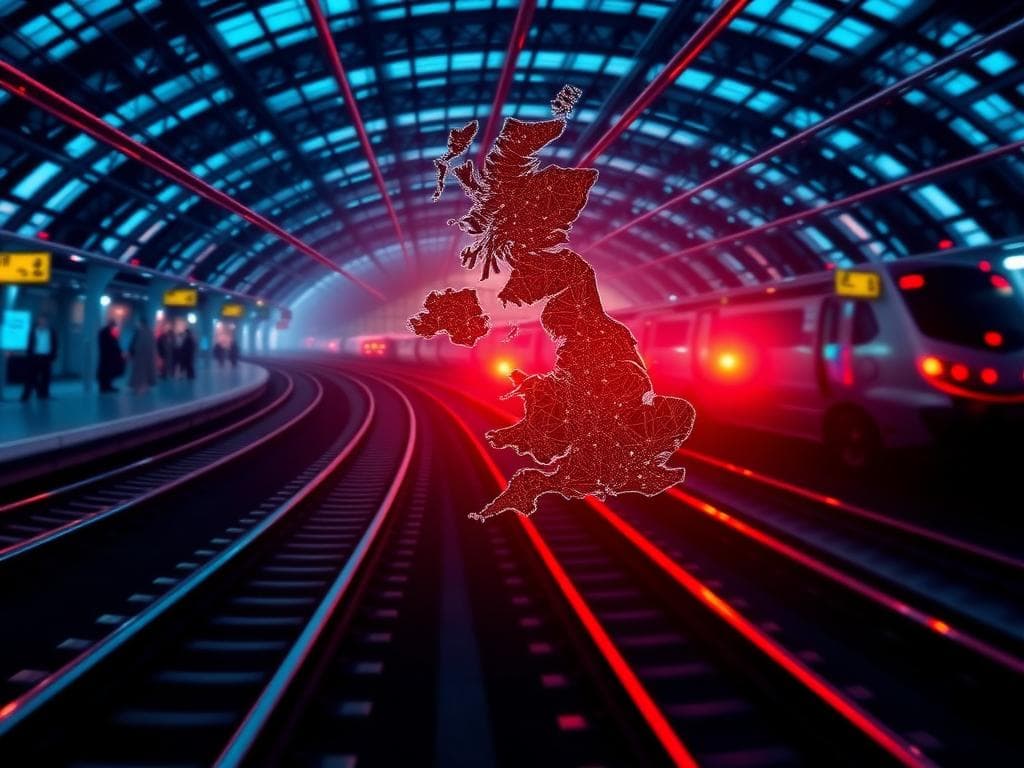
Real-Time Map of Great Britain's Rail Network: A New Era of Connectivity
Real-Time Visibility for a Complex Network
A new real-time map of Great Britain's rail network is now live, offering passengers and operators an unprecedented level of visibility into the country's intricate railway system. The interactive tool, which aggregates live data from Network Rail and all train operating companies, displays the precise location of every passenger and freight train in motion. This marks a significant step forward in operational transparency and passenger information.
The map updates every few seconds, showing train positions, service status, and estimated arrival times. It also highlights disruptions, engineering works, and speed restrictions in real time. For a network that handles over 1.7 billion passenger journeys annually, this level of granularity is a powerful tool for both travelers and logistics planners.
Cambridge South: A Benchmark for Sustainable Stations
While the real-time map improves digital infrastructure, physical infrastructure is also evolving. Cambridge South station, which opened to passengers on 28 June, has been hailed as the UK's first net zero carbon railway station. Designed by Arcadis, the station is expected to serve around 1.8 million passengers annually, improving access to the Cambridge Biomedical Campus, which is forecast to support 27,000 jobs by 2031.
Mike Gardner, Arcadis' UK Head of Stations, described the project as an example of how transport infrastructure can successfully combine sustainability, biodiversity, and community integration. The station is also the first in the country to carry Great British Railways branding, signaling a new era for national rail identity.
Arcadis utilized advanced digital engineering tools, including 3D modeling, drone surveys, and a common data environment to coordinate delivery across multiple stakeholders. This approach not only ensured precision but also set a new standard for future rail developments in the UK.
Private 5G: The Backbone of Future Rail
While the UK focuses on sustainable stations and real-time mapping, Latvia is testing the next generation of rail communications. LMT, in partnership with the national railway company, has begun demonstrating private 5G network technology on a passenger train route. The trials, conducted in late June, are measuring connection speed, network coverage, and signal strength to lay the groundwork for the Future Railway Mobile Communication System (FRMCS).
Unlike public networks, a private 5G network gives operators full control over communications capacity, ensuring immediate, low-latency data processing even in complex conditions. This enables real-time control of unmanned equipment and smart sensors, as well as the ability to send text messages, photos, and video files between dispatchers, drivers, and station staff. Such capabilities allow for rapid infrastructure inspections and timely updates on weather-related or repair-induced changes.
The implications for safety and efficiency are profound. With precise data accounting, operators can optimize energy consumption and respond quickly to infrastructure changes. This technology is not just about faster trains; it is about creating a more resilient and responsive railway ecosystem.
Global Context: From Eurail to High-Speed Networks
The push for real-time data and sustainable infrastructure in Great Britain is part of a broader global trend. In Europe, the Eurail pass remains a popular choice for travelers, with Switzerland, France, Austria, Germany, and Italy being the top five destinations for American tourists. Switzerland's premium panoramic routes, such as the Bernina Express and Glacier Express, offer floor-to-ceiling windows and 360-degree views, while France's TGV and Germany's ICE trains provide high-speed connectivity at up to 198 mph and 186 mph, respectively.
These networks are increasingly integrating digital tools to enhance passenger experience. For instance, Germany's ICE trains feature power outlets and onboard restaurants, while regional trains (RE/RB) are fully covered by Eurail passes. The contrast with the UK's real-time map highlights a global shift toward data-driven rail management.
Challenges and Resilience: The Ukraine Example
The importance of robust rail infrastructure is starkly illustrated by the ongoing conflict in Ukraine. Reuters reported that Russia has damaged more than 200 railway locomotives in 2026, underscoring the vulnerability of rail networks to geopolitical instability. This context makes the UK's investment in real-time monitoring and sustainable infrastructure not just a matter of convenience, but of national resilience.
Ukraine's rail network has been a critical lifeline for both civilian and military logistics. The damage to locomotives highlights the need for redundant systems and real-time asset tracking, capabilities that the new UK map aims to provide. The ability to reroute trains and manage capacity dynamically becomes essential in crisis scenarios.
Latvia's 5G Rail Trials: A Glimpse into the Future
In Latvia, LMT is preparing rail services for the FRMCS standard by testing private 5G networks. The trials, conducted in late June, focus on measuring connection speed, coverage, and signal strength. A private 5G network gives the company full control over communications capacity, ensuring low-latency data processing even in complex conditions.
Key benefits include the ability to control unmanned equipment and smart sensors in real time. The network operates autonomously, protected from external interference or overloads. This technology enables not only voice communications between dispatchers, drivers, and station staff but also the transmission of text messages, photos, and video files. This allows for rapid infrastructure inspections and timely updates on changes caused by weather or repairs.
This trial is a precursor to the FRMCS standard, which will eventually replace GSM-R across Europe. The ability to handle high-bandwidth data in real time is critical for future applications like autonomous train operation and predictive maintenance.
Why It Matters
The convergence of real-time mapping, sustainable station design, and next-generation communications represents a fundamental shift in how rail networks are managed and experienced. For passengers, this means more reliable journeys and better information. For operators, it means lower costs, higher efficiency, and improved safety.
The Cambridge South station sets a new benchmark for environmental performance, while the real-time map and 5G trials point to a future where data flows as freely as passengers. As the industry moves toward FRMCS and net zero targets, these developments are not just incremental improvements—they are foundational changes.
For the UK, which is also grappling with the aftermath of HS2 cost overruns and the need to upgrade aging infrastructure, these innovations offer a path forward. The combination of digital and physical upgrades could make the network more resilient to both everyday disruptions and extraordinary challenges, from extreme weather to geopolitical instability.
Related News

Tech Layoffs 2026: AI Drives 139,000+ Job Cuts in H1

Reddit Fights AI Spam with LLMs: A Digital Arms Race

Report: Microsoft lays off nearly 5,000 employees across Xbox, commercial sales ai enterprise microsoft
AI Model AmesNet Revolutionizes Drug Toxicity Screening
AI Breakthrough: AmesNet Predicts Drug Toxicity with Unprecedented Accuracy