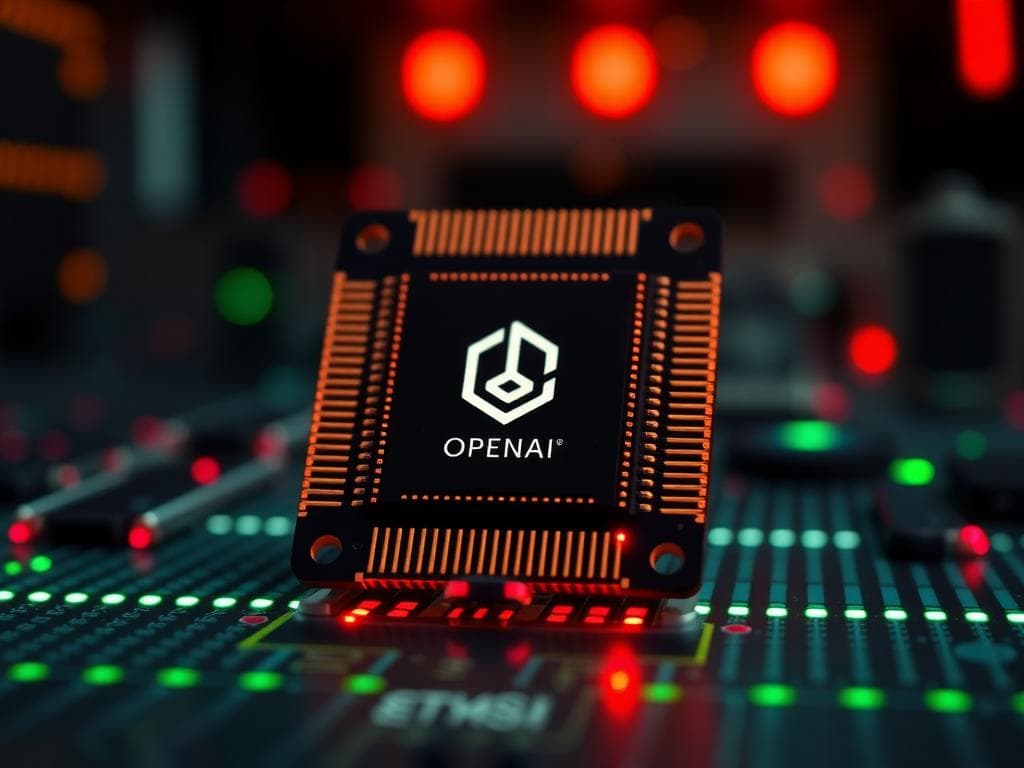
OpenAI Unveils 'Jalapeño,' Its First Custom AI Chip Built by Broadcom
OpenAI Enters the Silicon Race with Custom 'Jalapeño' AI Chip
In a strategic move to reshape its underlying infrastructure, OpenAI has unveiled its first custom artificial intelligence chip. Developed in partnership with semiconductor giant Broadcom, the processor, codenamed 'Jalapeño,' is designed specifically to handle the inference workloads of OpenAI's AI models, including ChatGPT and its coding agent, Codex.
The announcement, made on June 24, 2026, marks a pivotal step for the AI leader as it seeks greater control over its compute destiny. By designing its own silicon, OpenAI aims to reduce its heavy dependence on Nvidia's GPUs, optimize performance for its unique workloads, and ultimately improve the economics of running its massive AI services.
A Deep Dive into the Jalapeño Chip's Design and Purpose
Jalapeño is not a general-purpose processor. OpenAI hardware chief Richard Ho emphasized to Reuters that the chip is engineered to work 'speedily and efficiently' with the large language models (LLMs) that power its applications. The primary focus is on inference—the compute-intensive process of generating responses from a pre-trained model in real-time.
OpenAI president Greg Brockman, speaking on the company's podcast last year, framed the motivation clearly: 'We have a deep understanding of the workload,' he said. 'We've really been looking for specific workloads that are underserved, [and asking] how can we build something that will be able to accelerate what's possible?' Jalapeño appears to be the answer for their inference needs.
Technical Performance and Development Timeline
While still in the testing phase, OpenAI claims early results are promising. The company stated that Jalapeño is expected to deliver 'performance per watt substantially better than current state-of-the-art' alternatives. Broadcom CEO Hock Tan went further in an interview with Reuters, asserting the chip is 'as good as the Blackwell chips made by Nvidia or the tensor processing units designed by Alphabet's Google.'
The development was remarkably swift. OpenAI revealed that its engineers, assisted by its own AI models, completed the chip design in roughly nine months before sending it to Taiwan's TSMC for manufacturing. The partnership with Broadcom was officially announced in October 2025, following 18 months of prior collaboration.
The Strategic Shift: Reducing Dependence on Nvidia
OpenAI's foray into custom silicon follows a well-trodden path by other tech hyperscalers but represents a significant escalation in the AI compute arms race. Google has its Tensor Processing Units (TPUs), and Amazon Web Services offers the Trainium and Inferentia chips. For OpenAI, a company consuming vast amounts of compute, building its own chip is a logical step toward cost reduction and supply chain independence.
'OpenAI is not only developing frontier models or building products on top of them; it is designing the infrastructure underneath them,' the company wrote in its announcement. This vertical integration strategy allows OpenAI to optimize every layer of its stack—from chip architecture and memory systems to networking and deployment—around a single goal: making its models 'faster, more reliable, and more affordable for users.'
Market Context and Broader Implications
The launch of Jalapeño signals a maturation of the generative AI industry. As noted by Reuters, AI labs like OpenAI and Anthropic are locked in a fierce competition for scarce, expensive computing power. Developing in-house chips is a direct response to this bottleneck, offering a potential path to lower operational costs and a competitive edge.
Broadcom has emerged as a key enabler in this trend, leveraging its expertise to help cloud and AI companies design custom ASICs (Application-Specific Integrated Circuits). While less flexible than Nvidia's general-purpose GPUs, ASICs like Jalapeño can be more power-efficient and cost-effective for targeted tasks like AI inference.
Deployment Plans and the Road Ahead
OpenAI plans to begin deploying the Jalapeño chip in its data centers by the end of 2026. The systems integrating the chip will be built by Canadian electronics manufacturer Celestica and will be for OpenAI's exclusive use. The company emphasized that Jalapeño is the 'first step in a multi-generation chip development plan,' indicating this is not a one-off project but the foundation of a long-term hardware strategy.
It's important to note that this chip is specifically for inference. More performance-intensive tasks, such as the initial pre-training of massive models, will likely continue to rely on Nvidia's high-end GPUs for the foreseeable future. However, even marginal gains in inference efficiency can translate to massive cost savings at OpenAI's scale.
Why This Matters for the AI Ecosystem
OpenAI's entry into chip design is more than a technical footnote; it's a strategic inflection point. First, it underscores the critical importance of compute sovereignty for leading AI firms. Second, it applies pressure on the incumbent, Nvidia, while validating the custom silicon approach pioneered by Google and Amazon.
Finally, it suggests that the future of performant, affordable AI may depend on a diverse ecosystem of specialized hardware, not a single architecture. As OpenAI's Greg Brockman stated, the goal is to 'keep pushing advanced AI toward broader access.' The Jalapeño chip is a foundational piece in that ambitious puzzle.
Related News

Anthropic Accuses Alibaba of Largest-Ever AI Model Extraction Attack

FUTO Launches Open-Source Swipe Typing Model to Challenge Big Tech

VibeThinker-3B Challenges AI Giants, Raises Military AI Concerns

Canada's Nuclear Renaissance: $100B Plan Targets 10 Reactors by 2040

Swiss AI Initiative Launches Apertus: Open Foundation Model for Sovereign AI