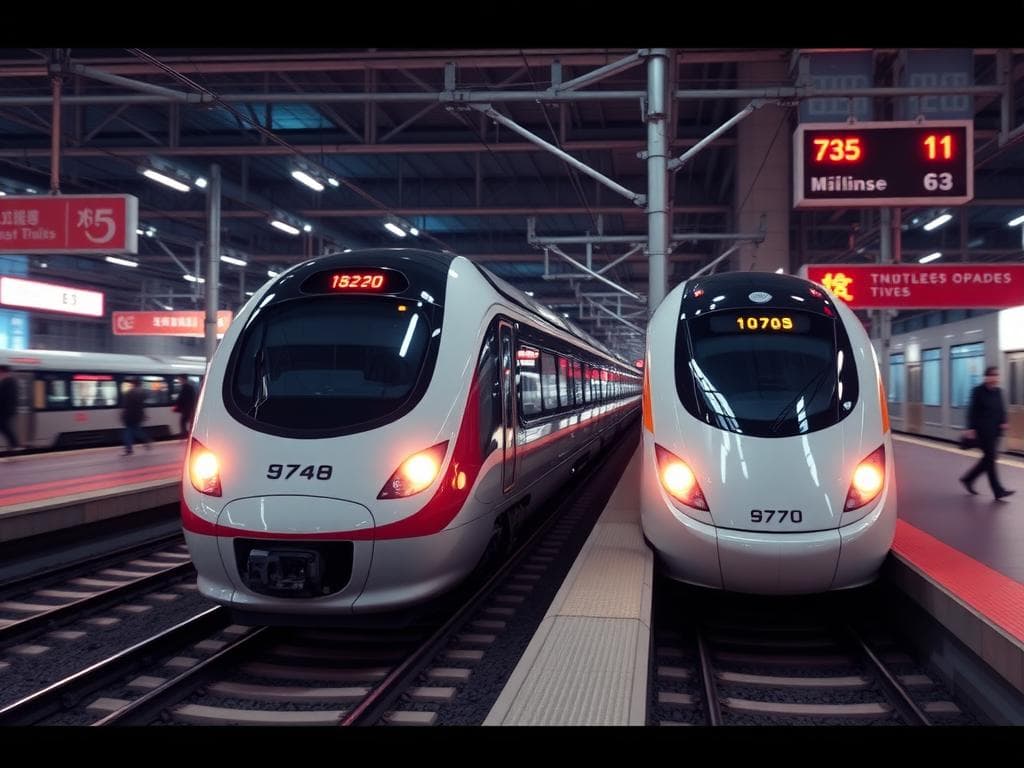
Japan's Railway Success: Policy, Not Culture, Fuels World-Best Trains
Japan's Railway Dominance: A Model Beyond Culture
Japan's railway system is a global benchmark, carrying 28% of all passenger kilometers within the country. This dwarfs the figures for France (10%), Germany (6.4%), and the United States (a mere 0.25%). JR East, the largest of Japan's many private operators, carries more passengers than the entire national rail systems of every country except China and India.
Commonly, this success is attributed to a unique cultural disposition towards conformity and public transit. However, a deeper analysis reveals this explanation is flawed. The Japanese affinity for cars is well-documented, yet they choose trains because the system is superior. The real foundation of Japan's rail supremacy is a suite of effective public policies.
This is profoundly good news for transportation planners worldwide. Culture evolves slowly over centuries, but successful policies can be adopted by any government with the will to implement them. Japan's formula offers a replicable blueprint.
The Pluralistic Private Network
Japan's vast network is divided among dozens of companies, nearly all privately owned. This ecosystem includes six Japan Railways (JR) Group companies, born from the 1988 privatization of the nationalized Japanese National Railways (JNR), and sixteen major "legacy private railways" that have always been private.
These legacy companies, like Tokyu and Hankyu, trace their roots to early 20th-century electric interurbans—similar to the systems that once crisscrossed the American Midwest but ultimately vanished. In Japan, they consolidated and evolved into heavy-rail networks. Crucially, they often compete directly; three separate lines run in parallel between Osaka and Kobe, sometimes less than 500 meters apart.
This competition fosters efficiency. Core rail operations are profitable for every private Japanese railway, a stark contrast to the heavily subsidized systems in Europe and North America. The JR companies, post-privatization, saw labor productivity soar as workforce numbers were halved and unprofitable lines were shed.
The Railway-as-City-Builder Business Model
The most distinctive feature of Japan's private railways is their business model. They are not merely transport providers; they are comprehensive urban developers. A commuter on the Tokyu network can live in a Tokyu-built house, shop at a Tokyu supermarket, work in a Tokyu office, visit a Tokyu hospital, and be entertained at a Tokyu cultural complex.
This model, pioneered by Hankyu Railways in the 1950s, solves a fundamental economic problem: railways create value for destinations they serve (shops, offices, homes) but cannot directly capture that value through fares alone. By owning the real estate and businesses around their stations, railway companies internalize these positive spillover effects.
As a result, rail operations often account for only a plurality of revenue, with the rest coming from side businesses. This creates a virtuous circle: better railways increase property values and commercial activity, which in turn feeds more ridership and revenue back into the railway.
Liberal Zoning and Transit-Oriented Development
This business model is enabled by Japan's liberal land-use regulations. Unlike the restrictive zoning common in the West, Japan's national zoning system since 1919 has allowed for dense, mixed-use development. Furthermore, mechanisms like "land readjustment" allow private entities, with agreement from two-thirds of local landowners, to replan entire neighborhoods, assembling land for amenities and infrastructure.
This allowed railways like Tokyu to execute massive projects. Its Den'en Toshi Line, built over 30 years through land readjustment covering 3,100 hectares, transformed a rural area into a suburb of over 500,000 people, with the railway funding the development by selling residential and commercial plots.
Japanese cities are not uniformly dense skyscraper forests. Their magic lies in hyper-dense, multi-layered urban cores—like Tokyo's Shibuya—where rail's spatial efficiency is unmatched. Getting millions into these small, activity-rich centers is where rail outcompetes the car.
Pricing Driving Correctly
Japan did not suppress car use through ideology; it simply forced private vehicles to internalize their costs. A key policy, enacted in the 1950s, was the effective privatization of parking. It is illegal to park on public roads or pavements without special permission.
Before buying a car, one must prove access to a private, off-street parking space. This eliminates the need for municipal parking minimums and lets the market decide land use. In central Tokyo, there are only 23 parking spaces per hectare, compared to 263 in Los Angeles.
Motorways are toll-funded, and vehicle taxes directly finance road construction. Consequently, in the Tokyo urban area, average household spending on cars is significantly higher than on public transport fares. Cars compete on a level playing field, and rail wins on merit in dense corridors.
Smart Regulation and Targeted Subsidies
The Japanese state plays a crucial but carefully circumscribed role. It imposes fare maximums to prevent monopoly abuse, but these caps are set generously based on regional average costs, allowing efficient operators like Tokyu to charge less and maximize ridership. Operators have full control over timetables and service patterns—technical decisions best left to experts.
While operational subsidies are minimal, the government provides targeted capital subsidies for projects with large public benefits, such as removing level crossings, earthquake-proofing, or improving disability access. These are often structured as loans or grants that must be repaid from fare revenue, ensuring fiscal discipline.
A Blueprint for the World
The lessons from Japan are clear. Successful railways require vertically integrated, private operators incentivized by profitability and competition. They must be allowed to capture the value they create through real estate development, enabled by liberal land-use rules that permit density. Competing modes, like driving, must pay their full cost.
As international projects like Canada's proposed high-speed rail corridor are evaluated, Japan's example is directly relevant. Experts point to the operational success of Japan's Shinkansen, which uses layered service patterns (Nozomi, Hikari, Kodama) to serve both major city pairs and intermediate stations efficiently.
Japan's system is not a cultural artifact. It is the result of specific, replicable policy choices that revived the 19th-century model of private, integrated railway development that also built America's first rail networks. By restoring these institutions, Japan has created the template for 21st-century passenger rail success.
Related News

Inside Fil-C: A Simplified Model for Memory-Safe C/C++

AI Agent Costs Rise, Challenging Productivity Gains (2026 Analysis)

Cloudflare Launches Unified AI Platform for the Agentic Internet

Cloudflare Email Service Enters Public Beta, Powering AI Agents

Google Faces Scrutiny Over Gmail Spam, Security Lapses Amid Broader Threats