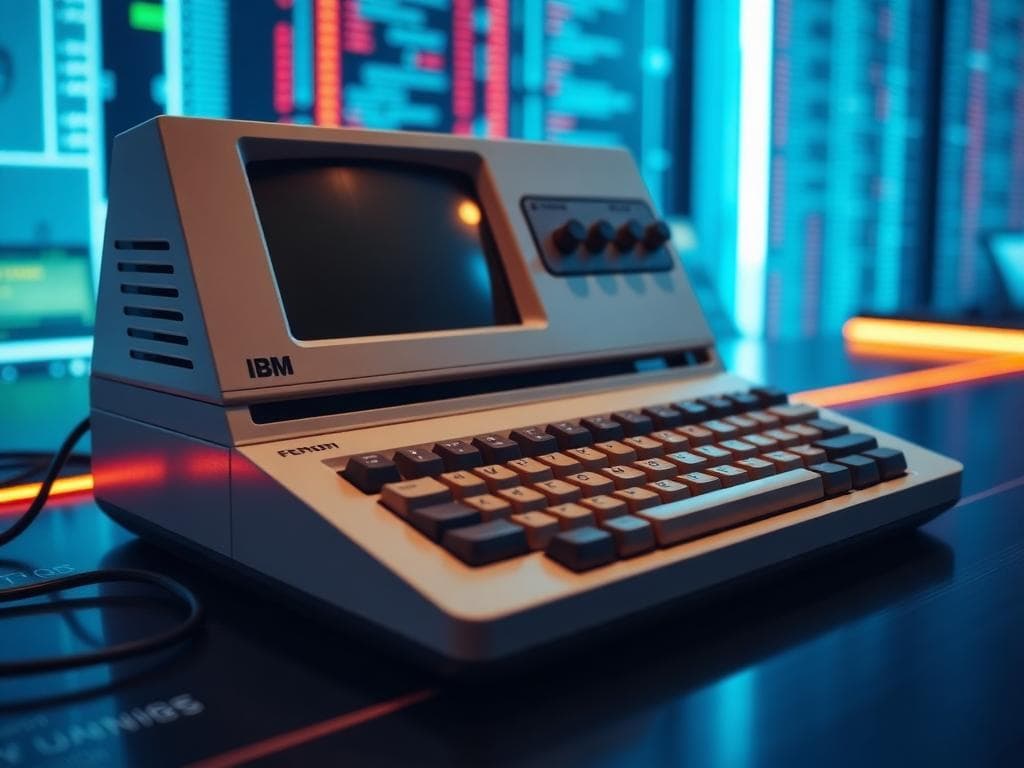
IBM PC and Model F/XT Turn 45: A Keyboard Legacy
Celebrating a Legacy: IBM PC and Model F/XT at 45
On August 12, 1981, IBM introduced the 5150 Personal Computer, a machine that would fundamentally reshape the computing landscape. While not the first 'personal' computer, its open architecture and choice of the Intel 8088 processor established the x86 ecosystem that still powers most of the world's desktops and laptops today. Yet, as this anniversary reminds us, a significant part of the PC's initial appeal was its keyboard—the Model F/XT.
This wasn't just any keyboard. It featured IBM's innovative capacitive buckling spring mechanism, offering a tactile and audible response that became legendary among enthusiasts. The Model F/XT's design and its variants tell a fascinating story of engineering, rapid development, and the birth of a standard that would influence keyboard design for decades.
From Project Chess to the Datamaster
The PC's development was famously unconventional for IBM. In July 1980, executive William Lowe pitched a small, low-cost computer to CEO Frank Cary, who gave the team just one month to produce a prototype and one year to launch. This 'Project Chess' team, led by Don Estridge after Lowe's promotion, operated outside IBM's typical bureaucratic processes, allowing them to meet the aggressive deadline.
Critical to this success was prior experience with the IBM System/23 Datamaster. The Datamaster, released just a month before the PC, was an Intel 8085-based system that served as a testing ground for many technologies the PC would adopt. Its keyboard, the earliest confirmed Model F implementation, established the core design: a steel frame, capacitive buckling springs, and a pad card with a 12x8 matrix. The PC team learned from the Datamaster's limitations, particularly its 64KB address space, which influenced the decision to use the 8088 with its 1MB capability.
The Model F/XT: Design and Evolution
The Model F/XT, officially the 'IBM Personal Computer Keyboard,' was a departure from the Datamaster's integrated approach. It used a new serial protocol, retroactively named 'IBM PC Mode 1,' which transmitted 9-bit packets with scancode set 1. The keycaps switched from EBCDIC to ASCII nomenclature, aligning with the PC's more open, standard-based philosophy.
Two major variants of the original F/XT exist. The rare Type 1, identifiable by its DIN plug lacking a plastic jacket and an internal reset line, used a split controller design with a separate daughterboard. The more common Type 2 reverted to a unified 12x8 matrix and integrated controller, simplifying production. This evolution reflected IBM's iterative approach, balancing component commonality with cost and performance.
Variants and Specialized Models
The F/XT's design spawned several notable variants. The IBM 5291/5292 terminals used a 'bigfoot' Model F with a larger bezel and three-setting riser feet. The 529X keyboard was produced the longest, even by Lexmark into the mid-1990s. The System 9000 family included a standard keyboard compatible with the F/XT and a rare 'hybrid' version integrating a membrane touch panel for the 9002 model, now considered one of the rarest Model Fs.
The Portable PC (5155) featured a lighter, all-plastic keyboard with an aluminum base plate and modular connector. For security-sensitive applications, the TEMPEST PC (TPC) family included keyboards with clay-filled controllers, non-coiled cables, and unique DE-9 connectors. The EMR Keyboard I even used a 180° DIN plug, making it physically incompatible with standard TPCs.
A Keyboard That Defined an Era
The Model F/XT's influence extends beyond its technical specs. Its buckling spring mechanism, later refined in the Model M, became a gold standard for tactile feedback. The keyboard's layout, with its function key column and dedicated nav cluster, set a template for PC keyboards that persists today.
As we mark 45 years, it's worth remembering that the IBM PC's success wasn't just about hardware specs—it was about the entire experience. The Model F/XT was a key part of that, proving that a well-built keyboard could be both functional and iconic. For enthusiasts and historians alike, it remains a testament to an era when IBM's engineering prowess met the dawn of the personal computing revolution.
Related News
AI Agents Discover 500+ Materials But Can't Synthesize Them

Mass Bot Spoofing Campaign Targets AI Crawlers in Vulnerability Scans

Researchers Expose Flaw in Encrypted LLM Reasoning Traces

AI Search Is Erasing the Internet's Collective Memory

Needle 2: 14MB On-Device LLM Brings Agentic AI to Budget Hardware