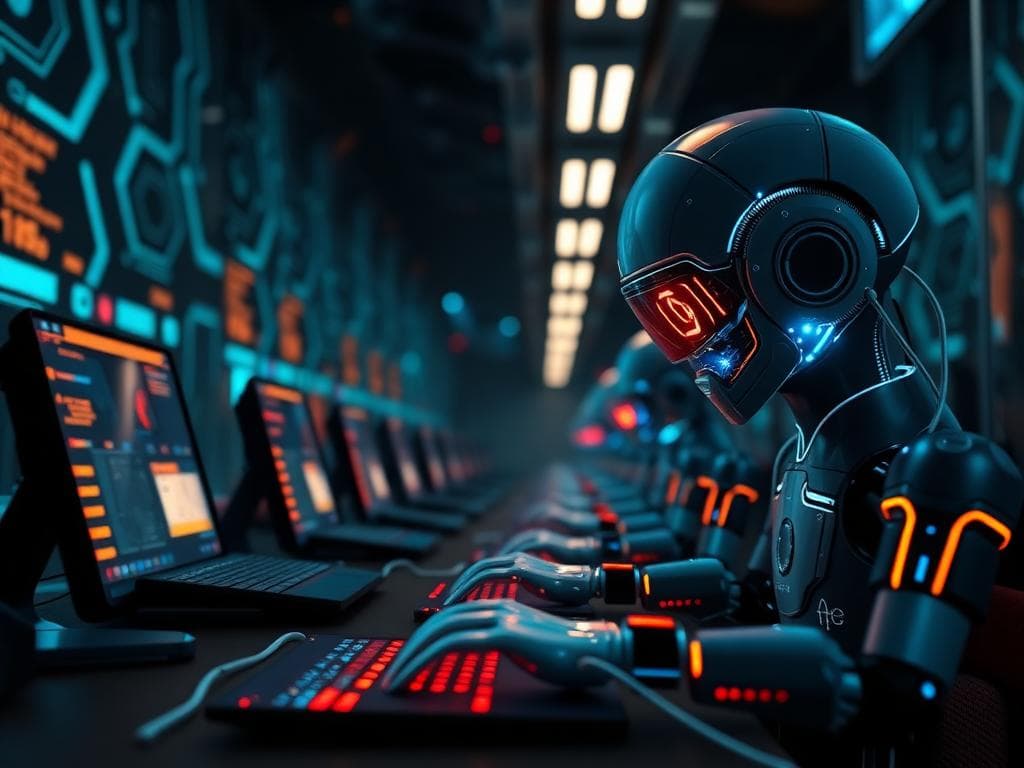
AI Coding Agents Force Software Engineering's 'Great Coding Reset'
The 'Great Coding Reset' Hits Software Engineering
The software engineering profession is undergoing a seismic, rapid transformation. Late 2025 saw a pivotal moment: the release of advanced AI models like Claude Code and OpenAI's Codex, followed by the MCP-powered Claude 4.5 and GPT 5.5. These tools didn't just assist; they began to automate core engineering pillars.
For a seasoned engineer with a decade of experience, this change has been visceral. He watched as his hard-won expertise in finance and payment systems became "promptable." LLMs could now connect the dots on complex topics like PCI compliance, double-entry ledgers, and payment lifecycle idempotency, tasks that once required years of domain immersion.
As he described in a recent blog post, his first shock came when management encouraged him to use AI more for writing design documents, a task he felt protected by his specialized knowledge. The second, more profound shock arrived when AI began solving complex bugs.
"Now I have CLIs that one-shots bugs across distributed systems for me," he wrote. Bugs that once took two days of intense debugging are now resolved by agents with tools like the Sentry MCP or DataDog MCP, requiring minimal human intervention.
Eroding Pillars: From Domain Expertise to Debugging
The engineer's story outlines three eroding pillars of traditional software engineering value. The first was domain-specific knowledge. In fields like finance, years of accumulated expertise are now accessible to any engineer with a capable LLM, leveling the playing field.
The second pillar was debugging and distributed systems intuition. Claude 4.5, while imperfect, solved a significant portion of bugs given a stack trace. Subsequent models like GPT 5.5 and Opus 4.8 have pushed this capability further, automating the resolution of bizarre race conditions and third-party integration issues.
The third, still-standing pillar is code quality and architecture—often reduced to the term "taste." While agents currently perform poorly at maintaining organized, SOLID-principle-adhering codebases, the industry's tolerance for lower-quality code is increasing.
"A `C` or `D`? It's now fine," the engineer notes, suggesting code is increasingly written for machines to parse, not humans to read. This final bastion of human expertise is itself diminishing in perceived value.
Industry Echoes: A Shift from Coding to Judgment
This engineer's experience is not isolated. Business Insider has labelled this period the "Great Coding Reset," noting that jobs once taking days are now done in hours. OpenAI's Andrej Karpathy remarked in February 2026 that it was "hard to communicate how much programming has changed due to AI in the last two months."
The consensus among leaders is clear: the role is evolving, not disappearing. Former Google distinguished engineer Kelsey Hightower argues AI isn't replacing software engineers—just ones who only know how to code. The value is shifting up the stack.
Similarly, analysis from the legal profession offers a parallel. Lawyers are advised not to compete with AI on summarization or templating, but to focus on defining the problem, making judgment calls, and owning the result. This framework applies directly to engineering.
Veteran engineers like Jason Young, with 30 years of experience, now feel more confident. "The writing of text—that isn't what being a software engineer is," Young told Business Insider. "Anyone who thinks otherwise has a wild misunderstanding."
The New Engineering Landscape: Adaptation and Oversight
The market is responding. Companies are moving away from hiring "Software Engineer - [Area]" specialists. Roles are now generic, with team assignment occurring after hiring. This democratizes opportunity but also increases competition among generalists, potentially depressing wages if demand doesn't keep pace.
Engineers who thrived on deep domain specialization now find themselves competing on the same generalist lane as others. As the anonymous engineer lamented, "All my finance and payment domain expertise... is now *promptable*."
The path forward requires a strategic pivot. The future belongs to engineers who can combine AI's speed with human judgment, legal experience (or, in engineering, system-level understanding), client understanding, and ethical responsibility.
This means focusing on skills machines cannot easily replicate:
- Problem Definition: Precisely articulating the *what* and *why* before any code is written.
- Architectural Taste & Judgment: Steering agents away from circular dependencies and spaghetti code, even as tolerance for imperfection grows.
- Cross-functional Communication: Bridging the gap between business stakeholders, product managers, and AI agents.
- Ownership & Accountability: Ultimately reviewing, validating, and owning every line of AI-generated code that reaches production.
Navigating the Uncertain Future
For many engineers, this shift prompts existential questions. Some consider pivoting to fields like advanced Machine Learning or research, though these paths are highly competitive and not immune to future AI advances. Others ponder leaving tech entirely for hands-on professions.
The data shows a modest uptick in software engineering job postings, suggesting demand persists but is morphing. With AI producing more code, more humans may be needed to oversee it, but these roles will look different.
The key is to adapt without surrendering the core human role. Engineers must use AI without letting AI use them. They must become faster and more efficient without becoming generic. The technology can produce code, but engineers must produce reliable, ethical, and impactful systems.
The "Great Coding Reset" is not the end of software engineering. It is, however, a forceful and accelerated evolution, demanding that professionals move beyond a pure coding identity and embrace their higher-order value as strategic problem-solvers and system stewards.
Related News
Anthropic's Fable AI Security Guardrails Spark Researcher Backlash
German Court Rules Google Liable for AI Overview Errors
Apple Announces macOS Golden Gate & Linux Container Machines
Apple Unveils AI Architecture Powered by Google Gemini Foundation Models

Xiaomi MiMo Hits 1000 TPS With 1T Model, Redefining AI Speed